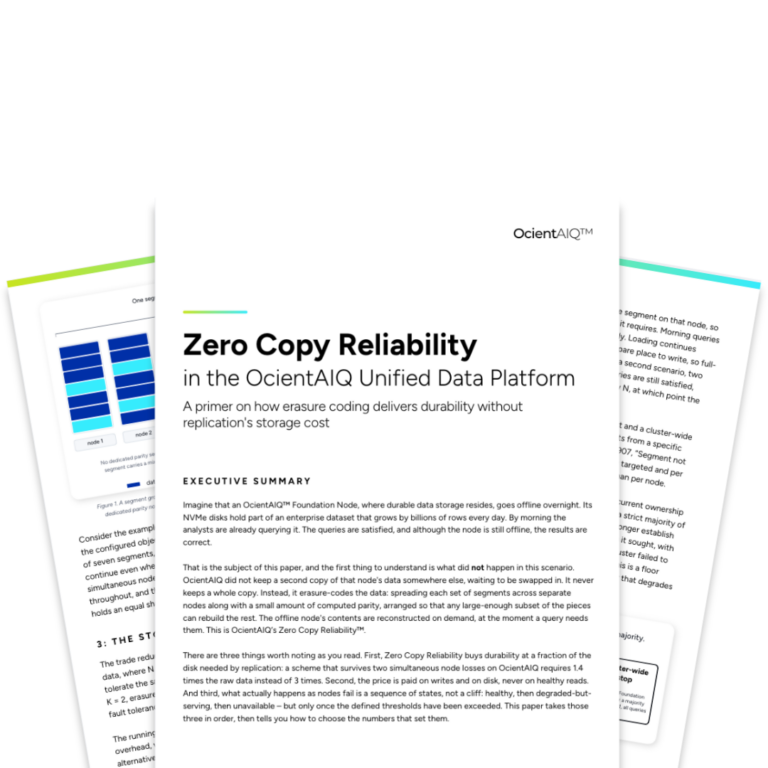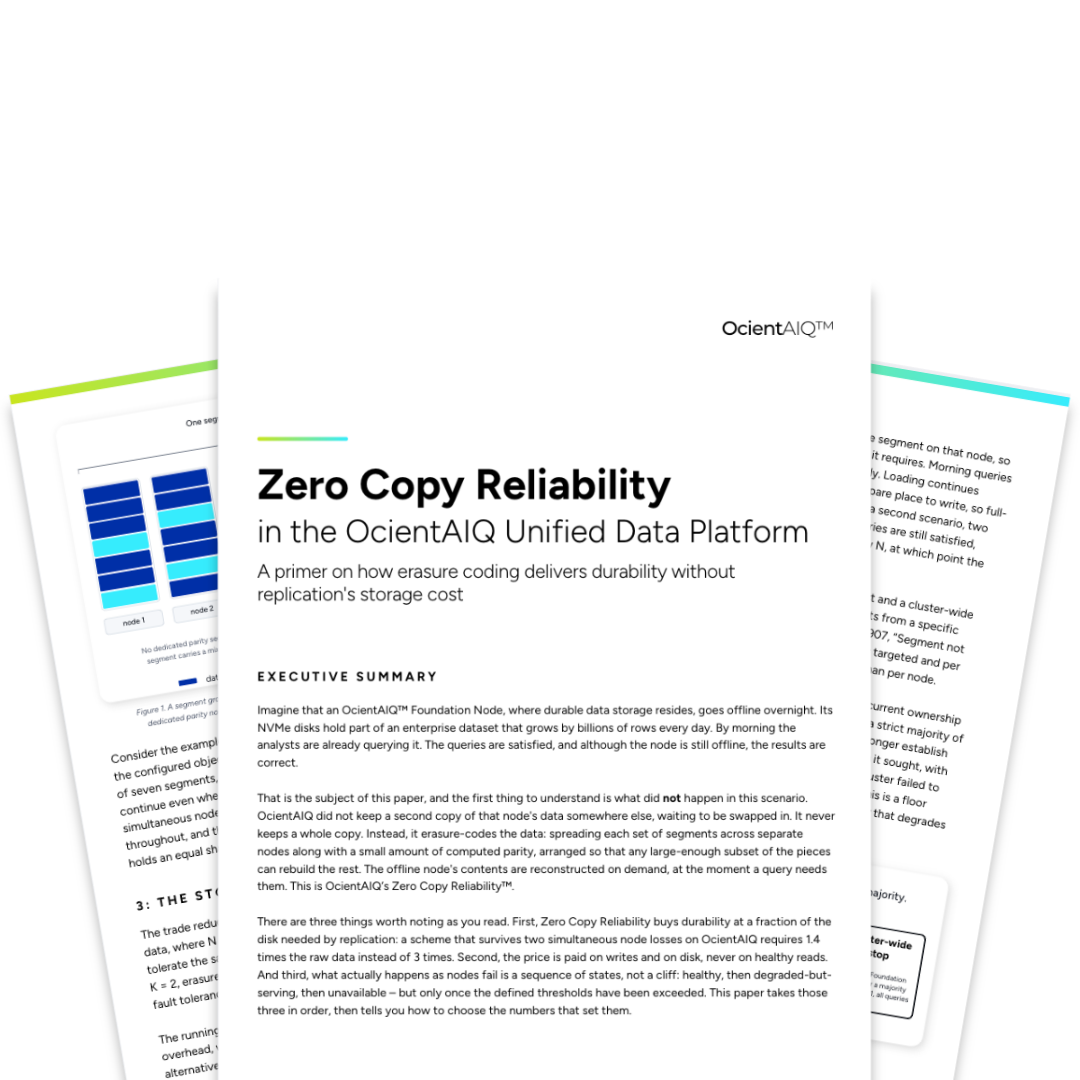
How erasure coding delivers replication-grade durability without replication's storage cost.
A Foundation Node goes offline overnight. By morning, analysts are querying the data it held, and the results are correct. No second copy was swapped in. The OcientAIQ™ Unified Data Platform never keeps one.
This 11-page technical paper explains how. It walks through the storage design behind Zero Copy Reliability™, what it costs, and exactly how the system behaves as nodes fail, so architects and platform engineers can size durability with real numbers.
What you’ll learn:
- The storage math: why surviving two simultaneous node losses takes 1.4x the raw data, not the 3x that triple replication requires
- Why healthy reads pay nothing: records are never split across segments, so there is no parity computation on the read path
- Where the cost actually lands: writes and disk, quantified for a 5+2 scheme
- What failure looks like: the four states from healthy to cluster-wide stop, the two thresholds between them, and the error codes at each
- Recovery: how rebuilds return segments to full redundancy, and how to monitor them
- Choosing the numbers: how to set data width, parity width, and overprovisioning for the failures you expect
Who it’s for: data architects, platform and infrastructure engineers, and technical evaluators sizing petabyte-scale analytics.
Short on time? Start with the three-page primer for the core ideas.