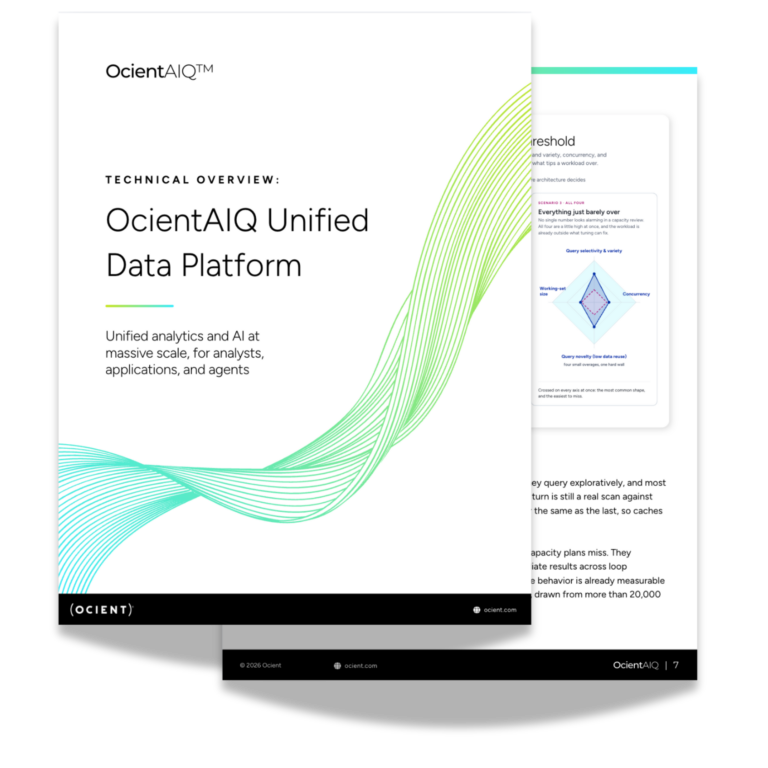
Unified analytics and AI at massive scale
With smaller workloads, cache hides architectural differences. As workloads grow larger, more varied, and more continuous, architecture starts to decide latency, cost, and reliability. Agents get there faster: they query continuously, explore paths no cache anticipated, and write intermediate results as they reason.
OcientAIQ brings relational, geospatial, machine learning, graph, vector, and real-time analytics into one engine over one copy of the data, with the same governance for every consumer. Agents orchestrate. OcientAIQ computes.
What you will learn:
- The threshold. Six signs a workload has reached the point where architecture, not tuning, determines outcomes.
- The modal tax. How tokens, accuracy, latency, and materialization costs compound when an agent works across a fragmented stack.
- Inside the engine. How Compute Adjacent Storage Architecture® (CASA), Smart Data Pipelines, and the cost-based optimizer deliver throughput on local NVMe.
- Six modalities, one statement. How cross-modal queries run in a single plan instead of across five tools and four exports.
- Governance for people and agents. One control plane, one audit trail, and workload management that treats agents as first-class users.
- Deployment and economics. On-premises, OcientCloud®, public cloud, or hybrid, with per-core, capacity-based pricing.